



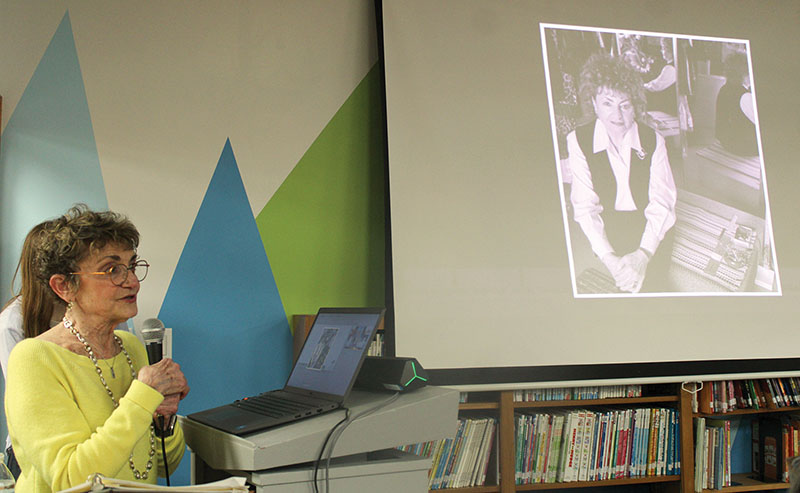
 Debbie Warshawski shows an image of her mother, Sonia, on the screen. Her mother is alive and well and living on her own at 100 years old. More than 100 people gathered Monday evening at Breese Public Library to hear the story of Holocaust survivor Sonia Warshawski, presented by her daughter, Debbie Warshawski.
Debbie shared the remarkable story of her mother’s survival during World War II, recounting the horrors Sonia endured as a young Jewish girl in Nazi-occupied Poland and the strength that carried her through concentration camps, forced labor and a death march.
Sonia Warshawski was 13 years old when World War II began in 1939. Her family lived in Miedzyrzec, Poland, where her grandfather owned a successful tailor business and the family operated a kosher restaurant.
“In 1939, World War II broke out and — as I’m sure most of you know — things would never be the same, and not just for the Jews in Poland or in Europe, but for everyone around the world pretty much,” Debbie said.
Debbie explained how her mother’s family was forced from their home and relocated to a ghetto area in town. Jewish residents were banned from schools, forbidden from walking on sidewalks and required to wear armbands identifying them as Jewish.
At one point, Sonia’s father created a hiding place beneath the floorboards of their small home. The family successfully hid during Nazi searches until German soldiers brought in a German shepherd that sniffed them out.
The family was then separated.
Debbie described how Sonia’s younger sister was upset and screaming, causing a scene, and their father entrusted her to a farmer (and paid money) in hopes of saving her sister's life.
Sonia and her mother (Debbie's grandmother) were later transported by train to the Majdanek concentration camp. Packed into rail cars without windows, many prisoners died from heat, thirst, starvation and disease before arriving.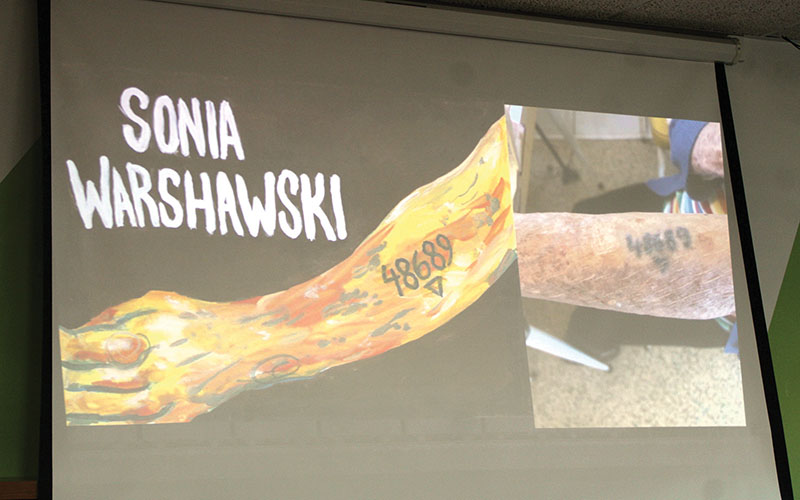 Sonia Warshawski was tattooed numbers on her arm at one of the concentration camps. A painting of one of the images, alongside the actual tattoo on Sonia’s forearm.
At Majdanek, they were given tattoos on their forearm, only identifying them as a number, and worked in the fields, witnessing unimaginable cruelty.
Debbie recounted a story from her mother of a public hanging of two girls who had attempted to escape the camp. Prisoners were forced to watch as the girls were executed. Debbie's grandmother had tried to look away, but one of the S.S. guards slapped her in the face.
“And as the two young girls walked up, one of them spat in the face of the S.S. guards, and the girl stopped and yelled at the crowd, ‘Never forget. Take revenge,’” Debbie said. "But, my mother never forgot those words — 'Never forget. Take revenge.' She said she was then hellbent on surviving. And that was not going to be an easy thing to do. In some cases, survival was luck, but in many other cases, it was the will and the smarts to survive."
Sonia and her mother survived several “selections,” where prisoners were separated and sent either to forced labor or to their deaths.
Eventually, however, Sonia’s mother was selected for the gas chambers.
“At the end of the summer, there was another big selection,” Debbie said. “My mother was sent to the right and her mother was sent to the left.”
Debbie said the last image Sonia had of her mother was watching her walk toward the gas chambers alongside another woman from their hometown.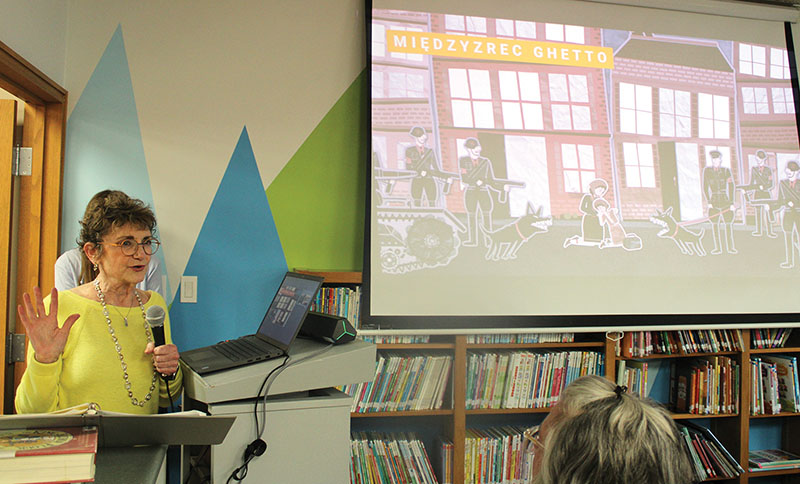 Debbie's family lived in Miedzyrzec, Poland, where her grandfather owned a successful tailor business and the family operated a kosher restaurant. They were then forced from their home and relocated to a ghetto area in town. “That was when my mother really fell apart,” she said.
Sonia was later transferred to Auschwitz-Birkenau, where she again worked in the fields until January 1945, when advancing Russian forces prompted the Nazis to evacuate prisoners.
Prisoners who were able to walk were forced onto a brutal death march through snow and freezing temperatures with little food and inadequate clothing. Many died along the way.
The march ended at Bergen-Belsen concentration camp, where Sonia worked peeling vegetables in the kitchen.
“When I came to Bergen-Belsen, I want you to know Bergen-Belsen did not have a gas chamber,” Sonia said in a documentary clip shown during the presentation. “It had a crematorium. They did not need a gas chamber because the typhus and the malnutrition was so great that the girls were just dying like flies.”
One day, Sonia noticed many of the S.S. guards had disappeared and felt vibrations from approaching tanks. Allied forces were liberating the camp.
But on the day of liberation, Sonia was accidentally shot in the chest.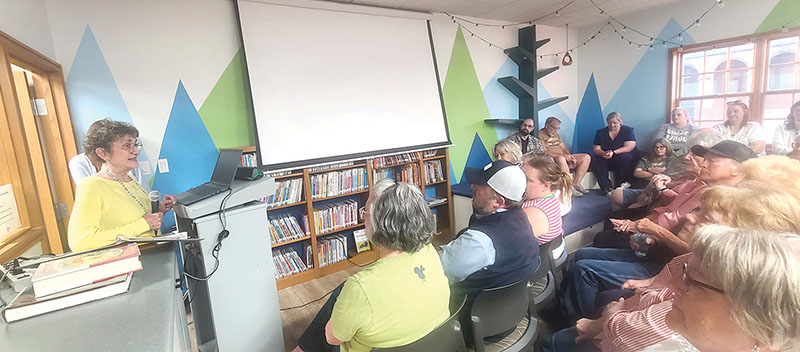 It was standing room only at Breese Public Library Monday evening as they heard a presentation from Debbie Warshawski, whose mother was a Holocaust survivor.
“I noticed that I had blood coming out of my mouth,” Sonia recalled in the documentary. “I was thinking, ‘God, after I went through so much, on the day of liberation, I have to perish.’”
She survived after receiving medical treatment.
Following the war, Sonia stayed at a displaced persons camp and later learned that her younger sister had survived after being cared for by farmers.
Sonia eventually met her husband, John, also a Holocaust survivor, and immigrated to Kansas City, Missouri, in 1948. Together, they raised three children and later welcomed grandchildren.
Where is Sonia now? Still alive and feisty as ever, at the age of 100 years old. She also still lives independently in her own home in Kansas City.
The presentation concluded with Debbie reflecting on the lasting impact the Holocaust had on survivors and the responsibility future generations carry in remembering their stories.
Debbie said she began speaking publicly about her mother’s experiences because Holocaust survivors and witnesses are aging, and it is important their stories continue to be told.
“Pretty soon, there won’t be witnesses, and there are people claiming that the Holocaust didn’t even happen,” Debbie said. “Evil can only succeed if we do or say nothing.”
She said her family is committed to ensuring the Holocaust is never forgotten or denied.
Debbie also spoke about the impact the experience had on survivors.
“On all survivors, there is a permanent, deep mark,” she said. “You are changed forever. You’ve seen things that no human being should see.”
The presentation also highlighted the documentary "Big Sonia," which tells Sonia’s story and has been shown in theaters and on PBS. The 2016 film was created and directed by Warshawski’s granddaughter Leah Warshawski and her husband, Todd Soliday, and covers Sonia's experience as a Holocaust survivor.
“It just says so much,” Debbie said. “My mother receives tons of letters from students and from people who have heard her story — people who feel like she changed and, in some respects, saved some of their lives. She likes to tell people that love is what you need and it's not her place to judge."