



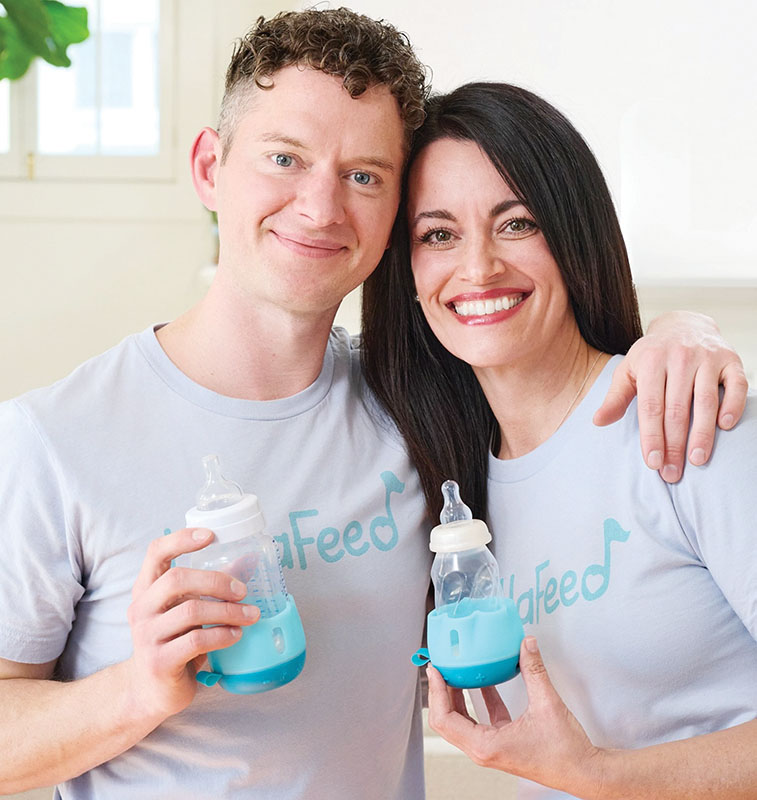
 Breese native Michael Detmer, along with co-founder Rebekah Gossom, have officially launched LullaFeed, a smart baby bottle attachment that uses soothing lullabies to encourage infants to feed. What started as a simple sketch of a baby bottle, a music note and a Bluetooth symbol has turned into an innovative product designed to help babies overcome feeding challenges.
And for Breese native Michael Detmer, it has been a long nine years in the making.
“Nine years later and a lot of gray hair, it’s exciting to get to this space,” said Detmer. “It’s been quite a journey.”
Detmer, along with co-founder Rebekah Gossom, have officially launched LullaFeed, a smart baby bottle attachment that uses soothing lullabies to encourage infants to feed.
The product combines music, technology and years of clinical research to help babies develop better feeding habits while strengthening the connection between infants and their caregivers.
Detmer, a 2006 graduate of Central Community High School and the son of Dale and Geri Detmer of Breese, said that the journey of creating LullaFeed wasn’t exactly one he had planned.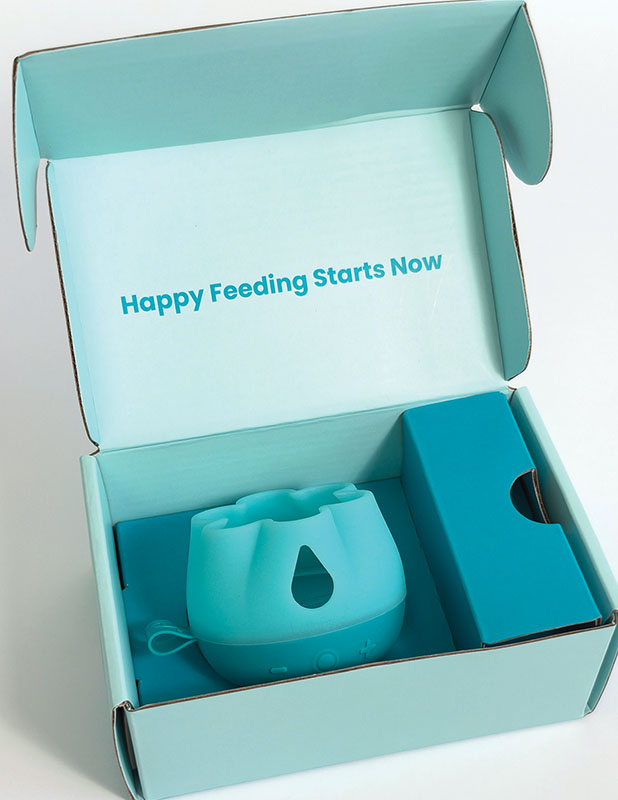 A photo of the packaging of Lullafeed, where "Happy Feeding Starts Now."
  In fact, becoming an entrepreneur and developing a one-of-a-kind baby product were never part of his original career plans.
Detmer initially attended Illinois State University, where he studied musical theater and music education. After spending time traveling and performing with theater groups, he began to feel that something was missing.
Although music had always been a passion, Detmer wanted to find a way to use that passion to make a greater difference in the lives of others.
“I have always been interested in health care and always wanted to do more in health care to help others,” he said. “I then learned about music therapy.”
That discovery eventually led Detmer down an entirely different career path, one that would combine his love for music with his desire to help others.
Detmer went back to school to become a board-certified music therapist. He never dreamt that this would lead him to help develop a product to help babies feed.
It all began back in 2017 while Detmer and Gossom were working together in the neonatal intensive care unit (NICU) at Norton Women’s and Children’s Hospital in Louisville, Kentucky. Detmer worked as a music therapist, while Gossom was a speech-language pathologist and infant feeding specialist.
Together, they both witnessed firsthand the struggles some premature and medically-fragile babies faced when learning to feed.
For many infants, feeding was one of the final milestones they needed to achieve before being discharged from the hospital.
“We wanted to do something more to help these kiddos who were checking off all the boxes for discharge except for feeding, and one day we found ourselves sketching out LullaFeed on paper,” Detmer said.
He recalled that their first concept was nothing fancy.
In fact, it was literally a clip art of a Bluetooth symbol, a music note and a baby bottle. But that simple drawing was the beginning of something much, much bigger.
Just weeks later, Detmer and Gossom found themselves pitching their idea to researchers, scientists and innovators at the University of Louisville Research and Innovation.
Their concept caught the attention of university officials and ultimately led to funding through the university’s National Institutes of Health-backed ExCITE program.
From there, the two began what would become a nine-year journey of research, product development, fundraising and determination.
Using music to help babies feed
LullaFeed was officially launched on Sept. 21. It is designed to make bottle feeding easier and more comfortable for infants who may have difficulty feeding.
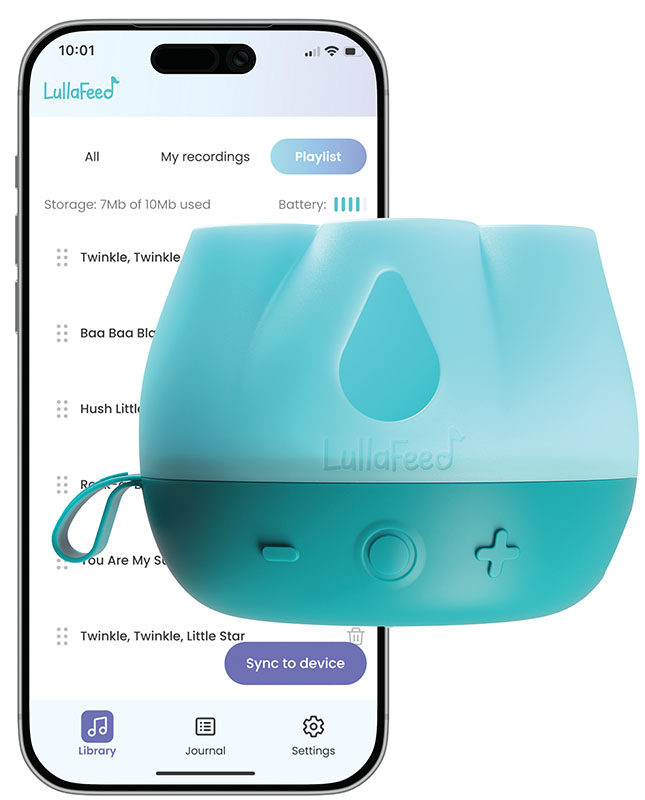
According to Detmer, Lullafeed is a soft, flexible device that attaches to the bottom of a baby bottle and uses built-in technology to detect when an infant is actively feeding.
As the baby drinks, soothing lullabies play through a built-in speaker. When the baby stops sucking or drinking, the music stops. And once feeding resumes, so does the music.
The concept uses a technique known as “contingent music reinforcement,” which encourages active sucking by providing an immediate musical response.
The approach is based on decades of clinical research into music therapy and infant feeding, Detmer said.
Detmer explained that for babies, especially those born prematurely, learning to coordinate sucking, swallowing and breathing can be challenging. Detmer and Gossom believed that the use of rhythmic lullabies can help support the process of suck, swallow and breathe.
LullaFeed also includes a smartphone app that allows parents to personalize their baby’s music.
Parents can create lullaby playlists or even record themselves singing, allowing their baby to hear a familiar voice during feeding.
The app also tracks feeding duration and patterns, giving parents and caregivers information to help monitor their baby’s progress over time.
The device was developed not only for babies experiencing feeding challenges, but also for families transitioning between breastfeeding and bottle feeding, parents returning to work and caregivers looking for additional ways to connect with their infants.
Nine years of determination
Although the original idea came together quickly, transforming the idea into a product ready for families took nearly a decade.
Along the way, Detmer and Gossom received support from researchers, investors and organizations that recognized the potential of their invention.
They participated in the XLerateHealth startup accelerator program and received investment support from Kentucky Science and Technology Corporation and Render Capital.
Their project also attracted support through a crowdfunding platform on Wefunder, raising approximately $548,000 from 90 investors.
However, Detmer said, the journey has been far from easy.
Detmer and Gossom spent years testing the product, including investing their own money and working through many setbacks.
“This was almost a decade of really hard work, and so much more money from our own bank accounts than I’m willing to admit,” said Detmer.
They also went through multiple rounds of beta testing and redesigned the device to make it as user-friendly as possible.
The earliest version included a sensor and battery inside the bottle that detected pressure changes as the baby fed. However, Detmer said that when parents may warm the bottle in the microwave, the battery may explode.
In another earlier version, the speaker for the music was positioned away from the bottle. During testing, the baby turned toward the speaker (and away from the mother) when the music started, showing Detmer and Gossom that the sound or music needed to come directly from the bottle.
The discovery led to a flexible attachment which is used today, where it can slide onto a variety of baby bottles, of all different sizes and types.
“Think of it (the attachment) similar to a can coozie,” said Detmer.
Despite the many challenges — and many bottles tested — Detmer and Gossom continued moving forward on their patented product. Their determination has also earned national and international awards and recognition, including awards from the National Institutes of Health, Mom’s Choice Awards, Baby Safety Alliance Awards of Excellence, and Baby Innovation Awards.
Now, after nine years of work, LullaFeed is officially available for purchase.
The product is sold directly to consumers through the company’s website, with plans to expand into retail stores.
For Detmer, the launch represents more than the successful development of a product — it is an opportunity to take the experiences he and Gossom gained while working with newborns in the hospital and make that support available to families beyond the NICU.
And to think, it all started with a simple sketch and a desire to help babies take one more step toward going home.
“We are just so thrilled that parents and babies can see the value in this, and it is so rewarding to bring this into the world,” said Detmer.
For additional information about LullaFeed, visit www.lul lafeed.com.