



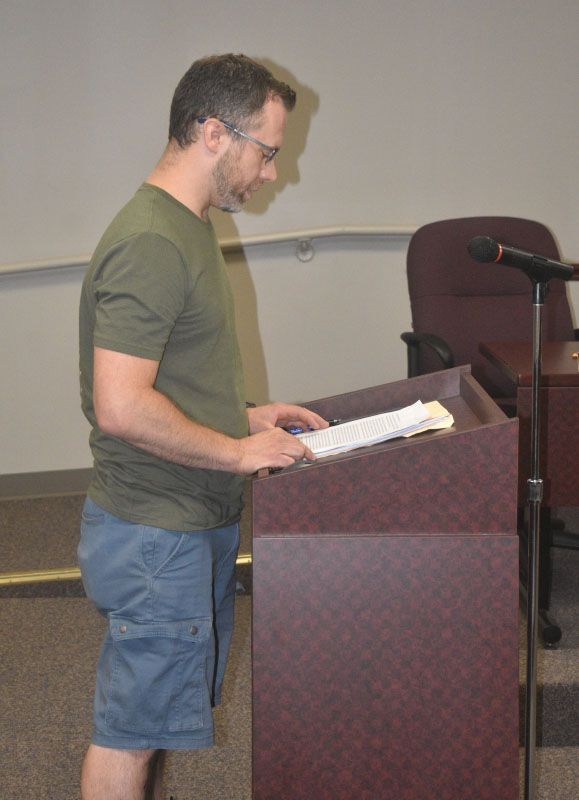
 David Gazda Jr. speaks to the Clinton County Board about a potential cell tower on Marydale Road. A group of area residents spoke to Clinton County board members about concerns regarding construction/placement of a proposed telecommunications facility (cell tower) on Marydale Road in rural Carlyle. The residents spoke during the public comment portion of the meeting on Monday, July 20.
David Gazda Jr., who lives across the road from the proposed tower site, said his biggest concern was that he thought there was a “lack of transparency” throughout the process.
Gazda Jr. said only a few residents received letters on June 13 informing them of the proposed tower and parcel location. After obtaining a copy of the zoning application from the Clinton County Zoning Office, residents found that the application, submitted by Kimley-Horn Consulting, indicated that all adjoining property owners had been notified.
According to Gazda Jr., the applications were signed June 2, but the notification letters were dated on June 8, and not received until June 13.
“So to me, they lied on the application that all adjoining property owners were notified,” Gazda Jr. said.
Gazda Jr. said residents contacted Sen. Jason Plummer’s office, where they were provided with an Illinois statute governing the placement of telecommunications towers near other properties. He said there was a Section 2 in the statute that states that the county board may give its approval after one public hearing on the proposal, but only by a favorable vote of the majority of the members present at the meeting, and held no later than 75 days after submission of a completed application by the telecommunications carrier. If the county fails to act within that time frame, the application is automatically approved.
Gazda Jr. then questioned whether a public hearing had been scheduled for the tower.
Residents also expressed concerns about how the proposed tower could affect nearby property values and resale value of their property.
Gazda Jr. cited information from the National Association of Realtors website that cell phone towers can impact property values, but the amount varies greatly from 7 to 30%. He said any amount is unacceptable.
“None of the adjacent landowners approved this tower, nor asked for it,” Gazda Jr. said. “We did not buy our properties and make our upgrades to them so the equity could be canceled out by a cell tower.”
Gazda Jr. said the landowner of the property in the proposed location lists his home address 20 miles from the site of the tower, therefore not impacting his resale value at all. Gazda Jr. said everyone chose to live on Marydale Road to live in a serene country setting, so why would they put a 260-foot tower right on the edge of the road. The height is equivalent to an 18-22 story office building at the height of the Statue of Liberty’s crown. The tower is one thing, but then there will be a fence and generators ruining the country setting.
Gazda Jr. said the Journal of Real Estate Finance Economic states homes close to towers sell for a discount of up to 7.6% and that any noticeable effect disappears at 1,500 feet. The proposed location is 315 feet from Gazda Jr.’s bedroom window.
Gazda Jr. said the residents are concerned about the safety hazards of a tower so close to their homes. According to reports, living close to a tower could cause higher cancer rates, biochemical changes and radio frequency symptoms. Children are vulnerable because their bodies absorb more of that radiation and their brains are still developing and are more sensitive to harm. Experts recommend at least 1,500 foot setbacks from homes to buildings to reduce risks.
“If there are any concerns about safety hazards with cell towers, why should we be the guinea pigs for such an experiment?” Gazda Jr. asked.
Gazda Jr. said the county board’s job is to establish policy on key areas such as property, public safety, and maintenance of county highways. He said the project could negatively impact their property and safety. He said they likely can’t stop the project from moving forward but asked the board’s assistance in pushing the location back off the road and within the perimeters of a 1,500 foot setback from any adjacent residents. The landowner owns 213 acres at the location, and the proposed site has a field road adjacent. The site being pushed back to the field road would allow an easy access point and give the residents of Marydale Road some peace of mind with the tower not looming over their homes.
“We will help you help us in any way we can,” Gazda Jr. said. “If you need more support against the location of this tower we can get a signed petition from residents in the area. Our Clinton County board has done well for a long time in limiting the solar and cell structures in our county, please don’t back down now.”
Clinton County Board president Brad Knolhoff asked Gazda Jr. about the state statute he referenced. Knolhoff said that was something he was not aware of and asked if Gazda Jr. could provide him with that statute.
Knolhoff said the information the county board has been given up to this point is in 2015, the state took away a lot of local regulatory authority on towers and that is what they have been relying on. Knolhoff told Gazda Jr. that the board concurs with everything he said and they have been fighting the “solar stuff” for years.
Zoning administrator Jami Staser said no building permit has been issued on the proposed tower. Towers used to be a special use permit, but the state changed its statute to towers being a “permitted use” in 2015.
Chadd Thompson has property on Marydale Road and operates an internet service on their property. They use a tower on their property about 1,500 feet from the proposed tower and they use their tower to provide wireless internet services to several people in the area and about 400 Clinton County residents. They have had their business since 2003 and all the equipment they use is super low power. Cell phone towers are hundreds of watts of power and while it may not be on an overlapping frequency as the equipment they use, just the high power could crush their business.
David Gazda Sr. asked if Clinton County has written plans for health issues related to cell phone towers; would Clinton County be ready if emergencies such as lightning happened near the tower; what happens if the tower falls and it lands on a vehicle and kills occupants; and if the tower falls on electric power lines when it is cold outside? He asked what effect does radiation have on people with respiratory problems? He asked about the rainwater that runs off the tower and floods his farm ground. He asked if the county checked how the water flow is now.
“The people of Marydale Road are concerned and it doesn’t seem fair they can come in and take over the peacefulness we have,” Gazda Sr. said. “I have owned my property for 53 years and have worked hard my whole life to enjoy retirement and the peace and quiet of the country.”
Barb Hempen said her family was approached to put the tower on their property. At first, they thought that would be something they wanted. She said she is not opposed to the tower, except for the location. She said it should be far away from everyone’s home to make it comfortable for everyone.
“It is a concern about the placement,” Hempen said.
Also during the meeting, radio committee chairman Curt Haselhorst said the emergency radio project is at a standstill due to interference between the transmitter and submitting. The delay pushes them back and the project will not be ready by August.
“It is good news and bad news,” Knolhoff said. “The bad news is it will be a little longer than what we initially hoped. The good news is the company is catching it and are going to make it right.”
Residents voice concerns over proposed tower on Marydale Road
- Details
- Written by: Matt Wilson - Breese Journal Reporter