



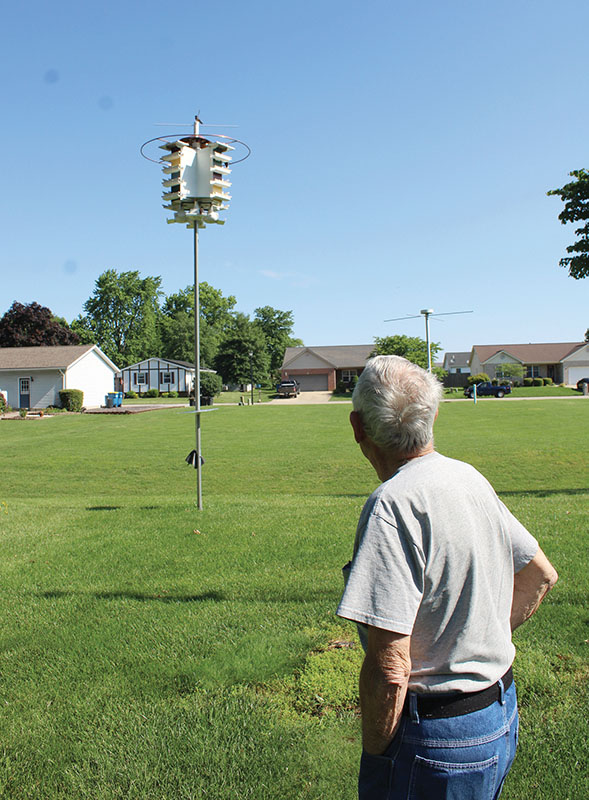
 One of the purple martin condominiums that Stan Meinhardt made stands nearly 18 feet high At 90 years old, Stan Meinhardt of New Baden has found a simple joy that never gets old — watching purple martins swoop and soar outside his window.
Nearly every morning in the spring, Meinhardt settles into his worn blue chair with a cup of coffee and a pair of binoculars, his eyes fixed on the sky behind his New Baden home.
“After all these years, I love them. They are so exciting to watch,” he said.
A lifelong fascination
Meinhardt’s love for birds began in childhood. Growing up near Mascoutah, he remembers his father crafting gourds and houses to attract purple martins.
That early exposure turned into a lifelong passion.
“When I got married, I started building purple martin houses,” Meinhardt said.
Today, his backyard is home to multiple martin structures — ranging from modified gourds to large, handmade “condominiums” designed with the birds’ comfort in mind.
Building homes in the sky 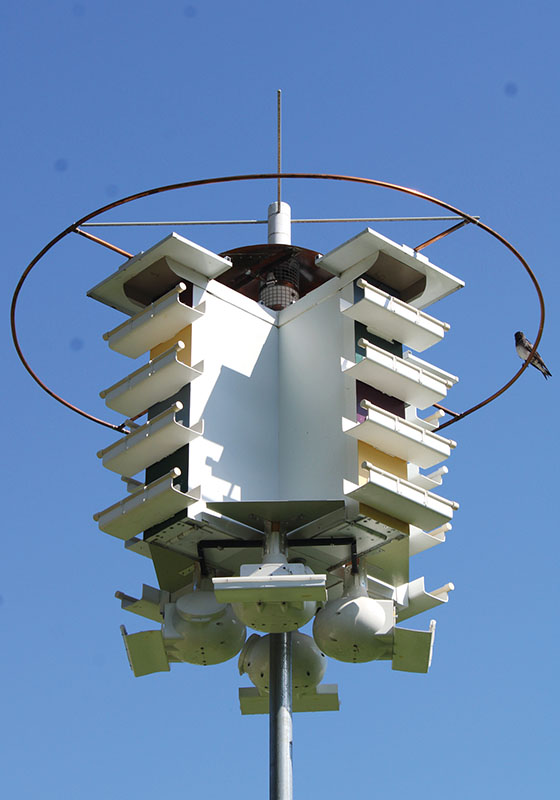 A closeup of the condominium and a purple martin
Meinhardt doesn’t just hang birdhouses — he engineers them.
Mounted on poles nearly 18 feet high, his houses can be lowered with a hand crank for cleaning and maintenance. Some feature dozens of compartments — one structure includes as many as 68 nesting holes.
“I started buying gourds, but there wasn’t much room,” he said. “So I made my own.”
His custom designs even include small balconies, giving the birds extra space to land and move safely.
“I made a balcony so they don’t fall when they come out,” he said.
Each winter, Meinhardt carefully takes the gourds down, cleans them, and prepares them for the birds’ return in early spring.
“I wait until the end of March when I see them, then I put them all back up,” he said.
A partnership with people
Purple martins are North America’s largest swallows. In the eastern United States, they rely almost entirely on humans for survival.
“They depend strictly on people to help them,” Meinhardt said.
The birds migrate thousands of miles from South America each year, arriving in southern states as early as January and reaching Illinois in the spring. Older males typically arrive first, claiming nesting spots before females and younger birds follow.
Purple martins are highly social birds, often nesting in large colonies where dozens of pairs live side by side. Each compartment typically houses a single pair.
The female lays four to six eggs, and both parents share the work of feeding their young. Within about a month, the chicks are ready to leave the nest, though many return to the same colony year after year.
But survival isn’t easy.
“They’ve got predators, such as raccoons, owls, hawks, snakes,” Meinhardt said. “Once a raccoon finds them, it can keep coming back.”
Life on the wing 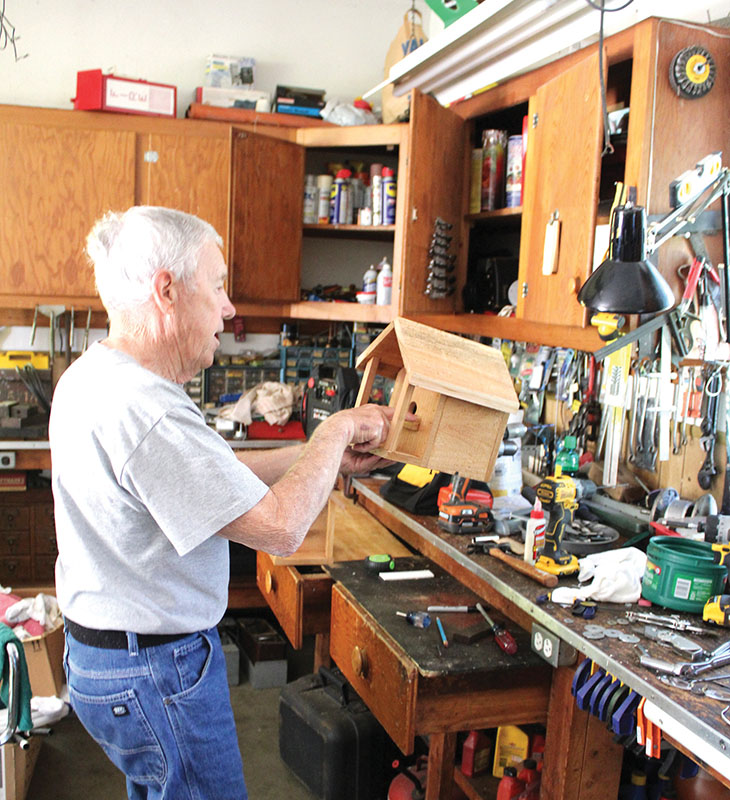 Stan Meinhardt holds up a wooden birdhouse that he recently made. Meinhardt enjoys woodworking and creating bird houses and purple martin condominiums.
Purple martins spend most of their lives in the air, catching insects mid-flight.
“They eat entirely on the wing,” Meinhardt said.
While many believe they mainly eat mosquitoes, their diet actually consists more of larger flying insects like dragonflies, beetles and moths.
“They’re working all day long out there,” he said. “You can watch them just constantly flying and feeding.”
Known for their agility, the birds twist, dive and glide with precision.
“They are real acrobatic,” he said. “They can fold their wings and just shoot through the air.”
Adult males appear a deep, glossy black, while females have a lighter, grayish underside. Younger males often have a speckled chest during their first year.
Why they need help from humans
In the eastern United States, purple martins have become almost entirely dependent on human-provided housing — a relationship that dates back generations.
Today, “martin landlords” like Meinhardt play a key role in their survival.
Proper placement, regular cleaning and protection from predators are essential. Without it, entire colonies can be lost.
Meinhardt even supplements their diet occasionally, putting out crushed eggshells and mealworms to give the birds extra nutrients.
A fading population 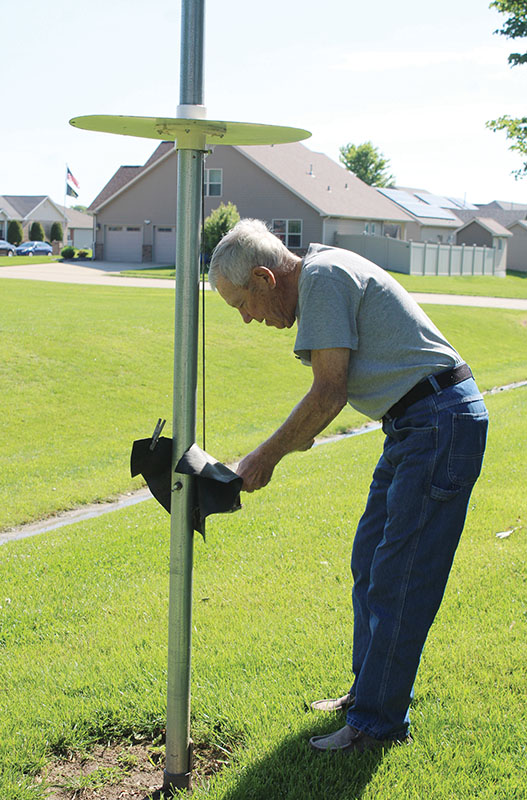 New Baden man Stan Meinhardt loves to engineer and make purple martin condominiums for purple martins that visit his home every spring. In this photo, Meinhardt uses a handcrank to raise and lower the bird condo.
Despite their beauty and charm, purple martin populations have declined in parts of North America.
“I think they need help,” Meinhardt said.
He keeps up with the birds through publications and stays connected with others who share his interest.
He estimates around 30 birds visit his property each season, though they come and go, making it hard to keep an exact count.
Passing it on
After decades of building, watching and caring for the birds, Meinhardt hopes others — especially younger generations — will take an interest.
“I’d like to see more young people get involved,” he said.
In Clinton County, there are quite a few folks who share their love for the purple martins.
In fact, there is a Facebook page, Clinton County Purple Martin Club, which is a forum for others to share information, ideas and pictures from their colonies. Enthusiasts from all over the county — New Baden, Aviston, Germantown and Bartelso — share pictures and sightings of purple martins online. Anyone who is interested in purple martins is welcome to join in on the page. Stan Meinhardt, 90, of New Baden, has always had a passion for purple martin birds.
So, if you see a purple martin condominium in someone's yard, or funny-looking gourds hanging nearby, Meinhardt encourages folks to stop and talk with the homeowner to learn what makes purple martins so special. More often than not, "martin landlords" are happy to share their passion for the birds.
But, for now, Meinhardt is content to sit back, sip his coffee, and watch the sky come alive each morning as he admires the purple martins.
“They’re fun to watch,” he said. “They love to sing, and they can be kind of noisy — but that’s part of it.”
As spring turns to summer, Meinhardt knows his backyard will once again fill with the swooping silhouettes and cheerful chatter of purple martins — a sight he’s cherished for decades.
Meinhardt, who will turn 91 in October, said he still looks forward to their return every year.
“They come back every year,” he said. “And as long as I’m here, I’ll be waiting for them.”
For the love of the birds — New Baden man finds joy in caring for purple martins
- Details
- Written by: Kelly Jo Ross - Breese Journal News Editor